There is a particular kind of tiredness that no facial can completely soften: the feeling of having given your energy to everyone else, then catching your reflection and barely recognising the woman looking back. Self love, self worth and self esteem are not luxuries reserved for the days when life is calm. They are the inner foundations that help you return to yourself when work is full, relationships feel demanding, or your own needs have slipped quietly to the bottom of the list.
At their heart, these three ideas invite a gentler question: how would your day change if you treated yourself as someone deeply worthy of care? Not as a reward for achieving more, looking a certain way or keeping everyone happy, but because you are already worthy.
Self love, self worth and self esteem are not the same
These terms are often used interchangeably, yet each speaks to a different part of your relationship with yourself. Understanding the distinction can make your self-care practice feel more honest and more useful.
Self love is the way you care for yourself in action. It is choosing rest before burnout, speaking to yourself with tenderness, nourishing your body and making room for what brings you back to life. It can be beautifully sensory: warm water on your skin, the scent of botanicals in your palms, a slow breath before the day begins. But self love also includes boundaries, difficult conversations and the choice to stop abandoning yourself for approval.
Self worth is your underlying belief that you matter, even when you are not producing, pleasing or performing. It is not something another person can grant you, nor something you lose when a relationship ends, your skin changes or a plan does not work out. Self worth says, “I am enough to be treated with respect, including by me.”
Self esteem is how you evaluate and trust yourself. It can rise when you honour a promise to yourself, learn a new skill or move through a challenge with courage. It can wobble after criticism, comparison or disappointment. That does not mean it is fragile by nature. It means it is asking for steady evidence that you can rely on yourself.
Think of self worth as the roots, self love as the nourishment, and self esteem as the confidence that grows when you keep tending both. You do not need to feel spectacular every day to have a healthy relationship with yourself. You simply need a way to come home to yourself, again and again.
Why beauty rituals can support emotional wellbeing
A skincare ritual cannot replace therapy, resolve grief or repair a relationship that is not safe. Yet it can become a meaningful daily cue: a few minutes where your attention returns to your own body, needs and inner voice.
For many women, skincare has been framed as correction. Cover the flaw. Fight the ageing. Fix what is wrong. A self-worth-led ritual offers a different experience. It asks you to care for your complexion because it belongs to you, not because you must earn the right to be seen.
The difference lies in the intention. Applying a facial mist in haste while criticising your appearance feels very different from pausing, pressing your hands gently to your face and noticing the woman beneath the rushing thoughts. The product can be exquisite, but the ritual becomes powerful when it carries respect.
This is also where consistency matters more than complexity. A ten-step routine that feels like another obligation may not serve you as deeply as two mindful minutes you can genuinely sustain. Your ritual should meet your real life, whether you are preparing for a busy morning, winding down after a long day or finding a quiet moment between family commitments.
A simple ritual for the days you feel disconnected
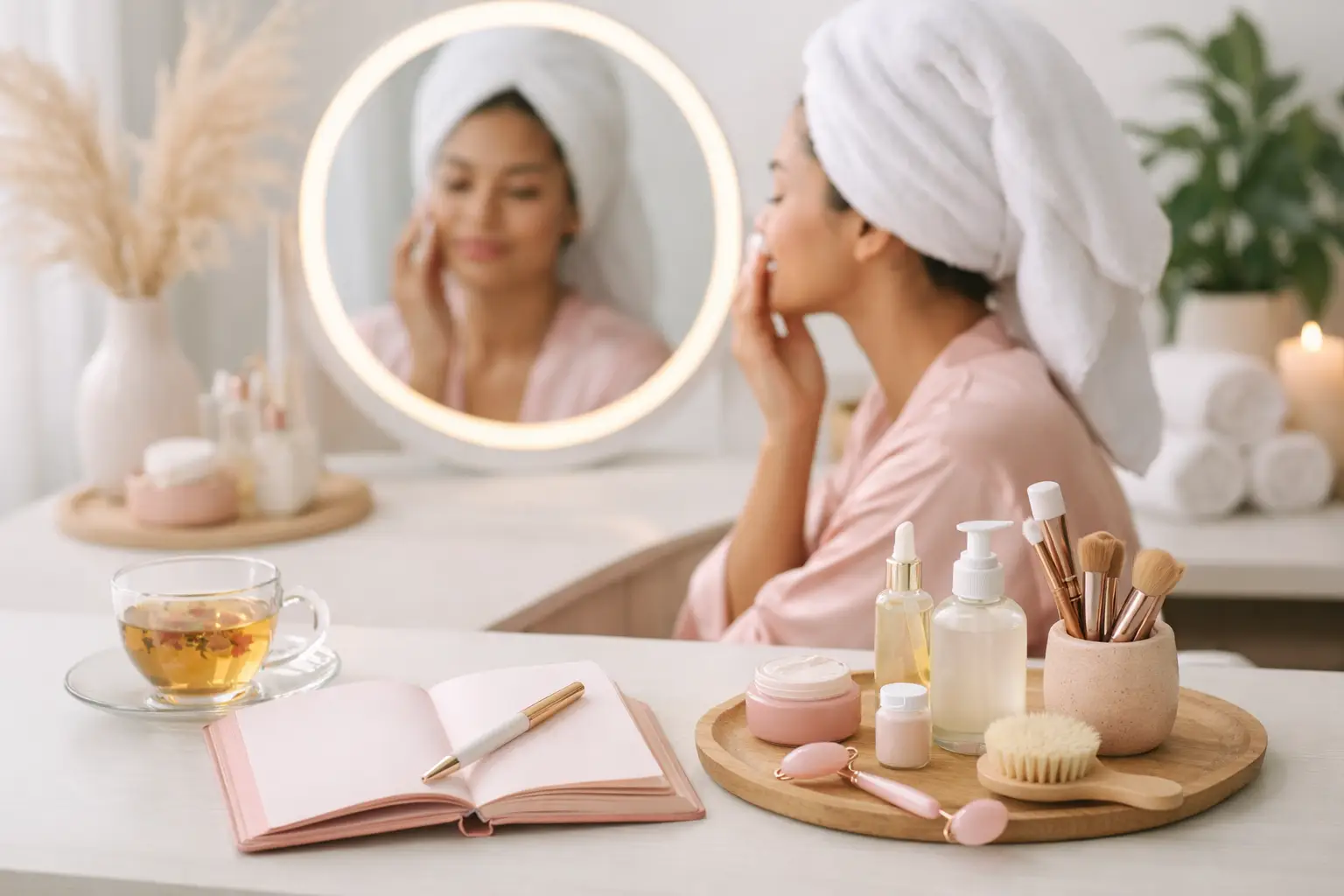
Begin by placing your mobile out of reach for a few minutes. Cleanse or mist your face as you normally would, then warm a few drops of facial oil or serum between your palms. Before applying it, take one unhurried breath in and a longer breath out.
As you massage the product over your face, neck or décolletage, use a phrase that feels believable rather than overly polished. You might say, “My needs matter,” “I can be kind to myself today,” or “I do not need to earn rest.” Let your hands move slowly enough that your nervous system can register the care.
Finish by asking one practical question: what would support me today? The answer may be water, a walk, a clear boundary, an earlier night or help from someone you trust. Self love becomes more than a lovely feeling when it informs a small, real decision.
Building self esteem through self-trust
Confidence is often mistaken for being the loudest person in the room or never feeling uncertain. In truth, self esteem is frequently quieter. It is the confidence of knowing you will not turn against yourself when something goes wrong.
You build this trust through the promises you keep, especially the modest ones. If you have promised yourself a nourishing breakfast, a ten-minute walk, a bedtime boundary or an honest conversation, following through sends a powerful message: I listen to myself. It is not about perfection. Life changes, children get sick, work runs late and energy fluctuates. When you cannot keep a promise, the practice is to respond with compassion and make a new one that fits reality.
Comparison can make this difficult, particularly in beauty spaces. Someone else’s glowing skin, effortless style or polished life can appear to confirm that you are behind. When comparison arises, try treating it as information instead of proof of inadequacy. Perhaps it is showing you a desire for more rest, creativity, friendship or self-expression. You can honour that desire without making yourself wrong.
It also helps to notice the language you use in private. Would you speak to a woman you love the way you speak to yourself after seeing an unflattering photo or making a mistake? Self-esteem grows when your inner voice becomes truthful and kind. Kindness does not mean pretending everything is wonderful. It means saying, “That was hard. I am still learning. I am still worthy.”
The role of boundaries in self worth
Sometimes the most loving ritual is not another product or practice. It is a boundary.
A boundary may look like declining an invitation when you need rest, asking for clearer communication, stepping back from a draining dynamic or refusing to explain your no repeatedly. It can feel uncomfortable at first, particularly if you have learned that being agreeable keeps the peace. But peace that costs you your own voice is rarely peace at all.
Boundaries are not punishments. They are instructions for how you wish to participate in relationships. They protect the time, energy and emotional safety needed for you to remain connected to yourself. And when a boundary brings guilt, it is worth remembering that guilt is not always a sign you have done something wrong. Sometimes it is simply the sensation of doing something new.
If low self-worth has been shaped by trauma, persistent anxiety, depression or a painful relationship, gentle rituals can sit alongside professional support. Speaking with a qualified mental health professional can offer the space and tools to understand patterns more deeply. Receiving support is not a failure of independence. It is an expression of self-respect.
Let your care be a daily declaration
At The Love Charm Collective, we believe botanical skincare can be part of a richer conversation about how you see yourself. The glow you seek is not only about luminosity on the surface. It is also the steadiness that comes from knowing your value is not up for debate.
Some days, self love will look like a beautiful evening ritual, soft light and a moment of quiet. Other days, it will be removing your makeup before bed, drinking a glass of water, cancelling a commitment or choosing not to chase someone who cannot meet you with care. Both count.
Your worth does not begin when you feel confident, youthful, productive or adored. It is present in the ordinary moments too. Let each small act of care remind you: you are allowed to take up space in your own life, to embrace your magic, and to glow naturally inside and out.